
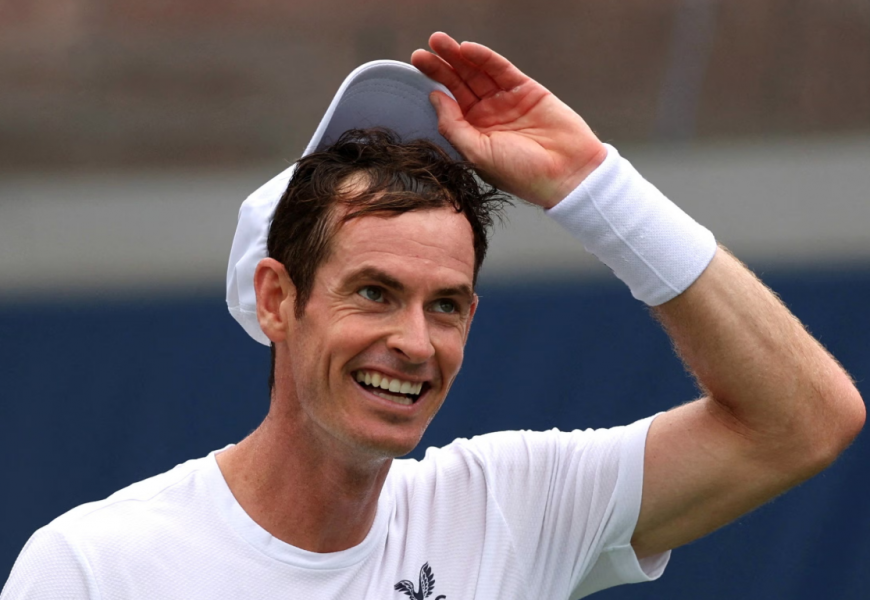
Andy Murray is one of the most important British athletes of the modern era. His career changed the meaning of British tennis in the twenty-first century, ending long waits, reshaping expectations, and proving that greatness can be built not only on talent, but on endurance, discipline, emotional honesty, and the refusal to disappear when the body and the pressure seem too heavy.
Born in Scotland in 1987, Murray grew up in Dunblane and became one of the defining tennis players of his generation. His rise came during one of the most difficult eras in the history of men’s tennis, when Roger Federer, Rafael Nadal, and Novak Djokovic dominated the sport. To compete in that environment required not simply excellence, but extraordinary persistence. Murray was not a player who collected titles in an easy age. He built his career by fighting against three of the greatest players ever to hold a racket.
Murray’s game was based on intelligence as much as power. He was an exceptional defender, a brilliant returner, and one of the best tactical players of his time. He could read opponents, change rhythm, absorb pressure, and turn defense into attack. While some players overwhelmed opponents with a single obvious weapon, Murray’s strength was his completeness. He could run, counterpunch, pass, lob, defend, return, and construct points with remarkable patience.
His emotional presence on court also made him distinctive. Murray never seemed detached from the struggle. He argued with himself, showed frustration, shouted, questioned, recovered, and fought again. This visibility of emotion made him relatable to many fans. He did not present tennis as effortless elegance. He showed the pain, doubt, anger, and courage required to survive at the highest level.
The breakthrough moment of his career came at the 2012 US Open, where he won his first Grand Slam title. That victory was historic because it ended a long drought for British men’s tennis at major championships. It also confirmed that Murray could cross the final psychological barrier after several painful defeats in major finals. Winning a Grand Slam was not only a sporting achievement; it was a release of national expectation.
His Wimbledon triumph in 2013 became one of the great moments in British sporting history. For decades, British fans had waited for a men’s singles champion at Wimbledon. When Murray defeated Novak Djokovic in the final, he ended a 77-year wait for a British male singles winner at the tournament. The victory carried enormous emotional weight because Wimbledon is not just another event in Britain; it is a national ritual. Murray’s win became part of the country’s sporting memory.
He won Wimbledon again in 2016, reinforcing that his first title had not been a single miracle but part of a larger career of excellence. That same year, he reached world No. 1, completing one of the most impressive seasons of his career. The ATP records Murray as a former world No. 1 and a winner of 46 ATP Tour singles titles, including three major titles.
Murray’s Olympic achievements are also central to his legacy. He won Olympic singles gold in London in 2012 and again in Rio in 2016, becoming the first tennis player to win two Olympic singles gold medals. These victories mattered deeply because they placed him in a different kind of sporting context. He was not only playing for himself, his ranking, or prize money; he was playing for Britain on one of the biggest stages in world sport.
One of the most admired parts of Murray’s career was his resilience through injury. Hip problems threatened to end his career and forced him through surgery, pain, uncertainty, and repeated comebacks. His emotional press conference before the 2019 Australian Open showed how close he was to the end. Yet he returned to professional tennis after hip resurfacing surgery, a remarkable achievement in itself. Even when he could no longer consistently compete at the level of his peak years, his willingness to keep fighting became part of his legend.
Murray officially retired from professional tennis after the Paris 2024 Olympics, closing a career that the Lawn Tennis Association summarized as spanning 19 years, 46 ATP Tour singles titles, three Olympic medals, and an extraordinary legacy for British tennis. His post-playing life has already begun to keep him connected to the sport, including coaching and public commentary on the evolution of tennis.
Beyond results, Murray also became respected for his public positions. He often spoke clearly about equality in sport and repeatedly challenged casual sexism in tennis coverage. He supported women’s tennis, credited female coaches, and used his platform in ways that broadened his importance beyond the court. His honesty, dry humor, and refusal to fit a simple celebrity mold made him one of the most interesting athletes of his generation.
Andy Murray’s legacy is therefore not limited to trophies. He changed British tennis psychologically. Before him, Wimbledon pressure often looked like a burden that crushed home hopes. Murray turned that burden into history. He showed that a British player could win the biggest titles in the most competitive era of modern tennis.
In the end, Andy Murray represents resilience more than perfection. His career was full of pain, near misses, comebacks, frustration, and triumph. That is why it meant so much. He did not make greatness look easy. He made it look earned.